
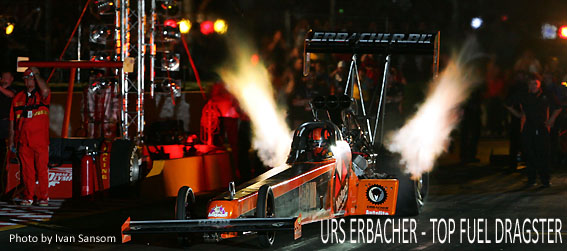
DRAG RACING – the very basics
In short it is all about acceleration –
travelling a short distance as quick as possible. From standing still.
In
a car or on a bike. A Top Fuel dragster is the world´s fastest
accelerating vehicle. Moving from 0-500 km/h in less than 5 seconds!
Drag racing
is said to have been born in the US, but today have many active teams in Europe as
in other parts of the world as well.
There
are different classes to include the whole range from street cars and
motorcycles to the most powerful vehicles, the Top Fuel Dragsters -
cars with more than 7.000 horsepowers and with speeds over 300 mph over
the finish line!
The race track in drag racing, also called
”the strip” measures 402.33 meters. That is equivalent to a 1/4 english
mile, often referred to as ”the quarter mile”. There are two parallel
lanes and opponents compete in pairs. Simply put, the first to cross
the finish line (without "redlighting") is the winner. The full track
distance be monitored from the grand stands, a fact that contributes to
making drag racing an appealing live action sport. The pit area is open
to the public, and spectators can follow the teams´ preparations in
between runs very closely.
The
European Championship events include two days of qualifying followed by
one ”elimination” day. The contestants qualify into elimination
ladders, with a limited number of spots in each category. The winner
from each heat moves on to the next heat, all the way to the final. The
starting procedure in drag racing is executed with the help of light
signals and set positions called "pre stage" and "stage". When the
vehicles pass the sensors at start line the timing starts. When the
finish line is crossed, the speed and elapsed time is monitored. There
are also timing checkpoints along the track.
The classes included in the FIA European Drag Racing Championship are:
FIA Top Fuel Dragster
FIA Top Methanol Dragster
FIA Top Methanol Funny Car
FIA Pro Modified
FIA Pro Stock